CASE STUDY // 01
AARRR-RARRA — The Funnel Blind Spot
A synthetic 12-month, 9-channel cohort dataset run through the AARRR-RARRA engine surfaces a real gap in its own Health Score: a channel that has never run a referral program and a channel whose referral program is actively failing land on the exact same score, every month, because the tool has no way to tell 'not tried' from 'tried and broken.'
85/100
Identical Health Score for two channels with opposite referral realities
0 of 15
Referral points assigned whether a program never existed or is actively failing
57/100
Health Score for Community — the one channel where the scoring logic actually works
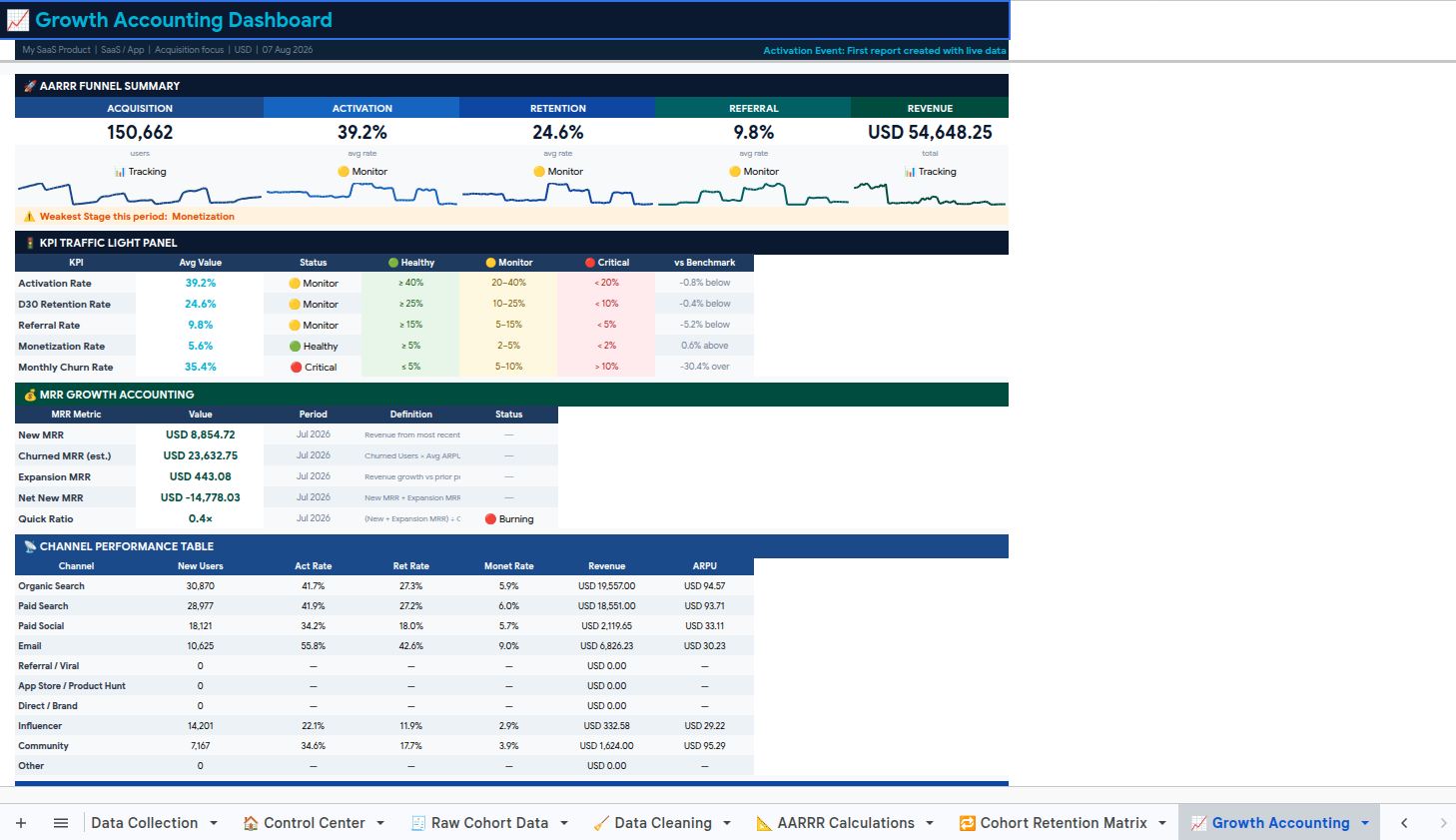
THE ACTUAL DASHBOARD
THE PROBLEM
A small SaaS team tracks Acquisition, Activation, Retention, Referral, and Revenue, usually as five spreadsheets nobody looks at together — or, when they do roll it into one Health Score, they trust that single number to mean what they think it means. It only does if every stage feeding it means the same thing every time.
THE RESOLUTION
The engine scores every cohort (one row per month x acquisition channel) across all five AARRR stages, applies traffic-light thresholds per stage, and rolls them into a weighted Health Score: Activation 25pts, Retention 30pts, Referral 15pts, Monetization 20pts, Churn 10pts. A Weakest Stage column flags which lever to pull next. Built in Google Sheets + Excel VBA — no dashboard software, no data team.
WHAT THE ENGINE DID
Cohort Scoring
Scored 108 monthly cohorts (12 months x 9 channels, including Organic Search, Paid Search, and Community) across Activation, Retention, Referral, and Monetization rates plus Churn, each against the tool's own documented traffic-light thresholds.
Referral Field Handling
Organic Search never ran a referral program — Referrals Sent and Referral Conversions are blank, not zero, per the schema's own 'blank means unmeasured' rule. Paid Search is running one, but it converts at roughly 3%, under the tool's 5% critical threshold.
Health Score Comparison
Both channels post identical Activation, Retention, Monetization, and Churn rates by design, isolating the Referral stage as the only variable. Computed the Health Score for both, every month, using the tool's own documented point weights.
Cross-Check Against Documentation
Checked the schema's own claim that stages with no data are 'not penalised for missing optional fields like Referral' against the Health Score weighting table sitting right next to that sentence.
THE RESULT
Organic Search and Paid Search post the exact same Health Score — 85 out of 100 — in all 12 months of the dataset. The Health Score weighting table assigns 0 of 15 Referral points to a blank field and 0 of 15 to a red (under-5%) referral rate; there's no third bucket. So a channel that has simply never built a referral loop and a channel whose referral loop is actively broken are mathematically indistinguishable in the one number the dashboard hands the owner. Only reading the underlying Referral Flag column directly (a dash for Organic Search, a red flag for Paid Search) tells them apart — the composite score erases the difference. A third channel, Community, correctly scores lower (57, Monitor band) for genuinely weaker Activation and Retention, showing the scoring logic works everywhere except this one blind spot. Illustrative synthetic data — not a real client result.